Wednesday, October 29, 2014

Comics as Contemporary Literature


I really enjoyed reading Asterios Polyp. I think most of my love came from the style of it. It felt well designed and went hand in hand with the story of an architecture professor. I especially enjoyed the page that broke down his figure into simple shapes. In fact, I noticed many of the characters seemed like different styles depending on their background and/or personality, such as the scene above. It really tells the story of the characters without bashing you over the head with it like many comics do to any "background" character.

Let's talk more about the above scene. We are drawn to the main characters in the middle but all the other characters aren't interested in them. As such a focus that clearly marks a change of moment, the reader is the only one to notice. Also, notice how they are in a similar style. It's the scene when they meet for the first time and the female character talks about how he intrigued her from the moment. His style has influenced her.

She is believing in him that she starts to gain a new look on life from him. That's what I found so interesting about it. There are more visual cues in the panels that really bring the story to life.

Wednesday, October 22, 2014

Intro to Manga: How amazing FLCL is

Besides being introduced to comics, I found love in manga. I can't quite remember what first brought me into the world of Manga but I was hooked. That's all I read for about 10 years. I read them occasionally now but with school I barely have time to keep up. I'm very picky, as I put the style/art before the story. I must feel attracted to it at first before wondering what the story is. Also, I like specific genres such as slice of life, action, comedy, and sometimes horror stories. It really just depends on my mood.


I re-watched FLCL as it is one of my favorite anime. Definitely something I shouldn't have watched when I was 9; but all I knew back then was Cartoon Network and Toonami. I even bought the manga when I saw it one time in Borders. Both volumes. I remember buying another series because of the mangaka. Anyway, I have to say the style of the manga is lovely quick pen sketches and even the story differs in a more mature but also very confusing and needs to be re-read a few times to uncover the story. There's a lot of deep thoughts and metaphors in the manga so I definitely say anyone who watched the anime should read the manga. Also, they leave the ending open. Not saying I hate the ending but it leaves you in a spot that makes you wonder what the future holds for the characters.

Haruko's character is practically the same but the whole ending I found way better than the anime. However, I still love the ending to the anime and the song in it. Instead of her fighting Atomsk and kissing Naota at the end before leaving, which she still does in the manga, the town is being destroyed by a robot controlled by Haruko. Things happen, "Rahal Haru-Hara" shows up and she makes out with Naota before leaving him with the vespa, in which he tries to ride it. Then it ends.

Thursday, October 16, 2014

Eurocomics

Here's a short blog on what I read this week.

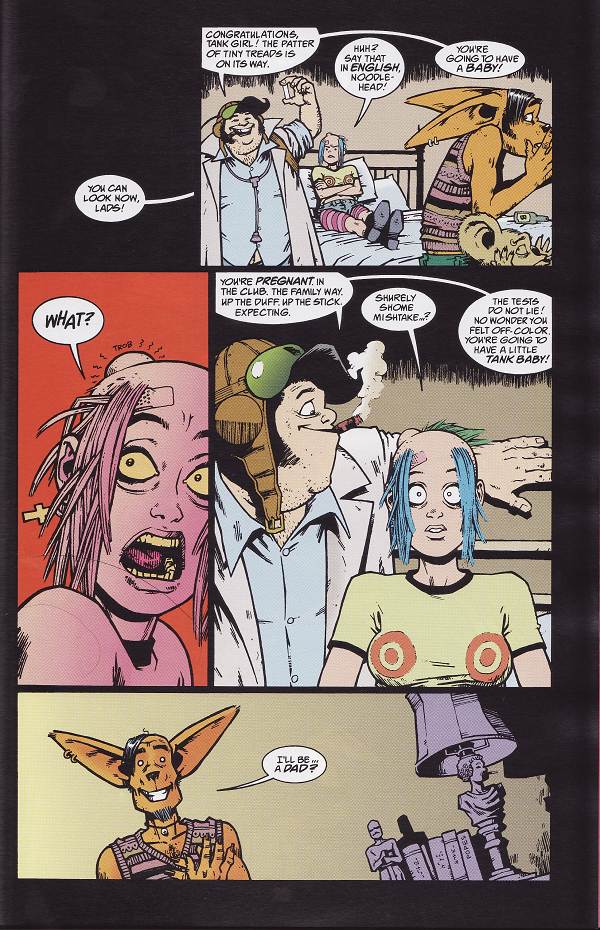
I immediately gravitated to Tank Girl. A punk story of a girl who lives in a Tank and dates a kangaroo man? For those of you who haven't heard of her: It's full of sex, violence, and humor. Also, the art is fantastic! I read Apocalypse, which can be taken as more of a spin off as it deals with the story of Tank Girl being pregnant.

Tank Girl, the person who seems the most unlikely to raise a child, is having a baby. If you want to know, she does have it in the end. Any guesses to what it looks like? I'll give you a hint: It's in her name. Yes, she gives birth to a glorious baby with a tank body from it's stomach down. If that doesn't make you curious on who Tank Girl is, just remember that there was a live action movie about her.


Wednesday, October 8, 2014

March: Book One

I was attracted to the style of the graphic novel at first. It's interesting and I feel it works well with the message they want to have. In the few pages I was able to find of the novel, Lewis wanted to desegregate Troy State. Throughout the comic, the idea of non-violence is repeated. It's a huge subject about any protest/movement. Movements are meant to be peaceful so showing no acts of violence makes a bigger impact.


John Lewis actually spoke at the March back in 1968. He was became the president of the SNCC (Student Non-violent Coordinating Committee) and then the Congressman from Georgia. It all started when one of his staffers, Andrew Aydin, said he was going to a comic book convention. That prompted Lewis to talk about a comic book he was inspired by. That comic book was Martin Luther King Jr and the Montgomery Story. From that he learned about Rosa Parks and how to protest non-violently. I feel that's something we have gained, especially with the recent protests around the world.

Maus


I was already skeptical of reading this as the cover gives off a Holocaust look. It's kind of interesting way of showing it. First of all, It's a story of a story, not a form of propaganda as the graphic novel came out in 1980. A father is telling his son about his experience during the time and how he survived it. I find the simplistic style to really help with the story. The Holocaust was a dark time and to have something more "friendly" and open is a better way for reading on the time period. It has dark themes, of course, but is well handled.

The use of mice, a typical animal used in experiments, as the Jews and other animals such as pigs and cats as Nazis was interesting. Harmless mice that go about their lives and are soon faced with the horrors of the Holocaust. A lot of things are revealed on the father son relationship, as well as, his mother's suicide.


I read up on what made Spiegelman want to illustrate the Holocaust, as he wanted to do a strip on racism. It's interesting to see how the original strip wasn't as simple as it is now. He had some information from his mother to back up some illustrations but it wasn't until he learned more from his father that he was really interested.

Wednesday, September 24, 2014

Underground Comix

So first off what aren't underground comix. Some may think that they are the same as indie comics in which they are both not affiliated with a publishing company and the artist has full control over their story, art, and characters. They aren't kid friendly. Think about South Park: it's crude but has adult themes to it. That is what underground comix are.

I chose to read Dopin' Dan first, a comic set around the the army. It's crude with a simplistic design. Nothing extremely bad n the one I was reading, but with a clear stereotype of characters we think of when we imagine the military. The typical rough sergeant who picks on his crew and the pranks they play on him. There's some sexual reference but other than that it's just a bunch of jokes. Maybe I just didn't fully get it's humor or something. I do know that it wasn't my cup of tea.


Then I decided to read Fight Girls as I could already tell I was in store for something outrageous. Sure enough, it was women themed and included sexual encounters and such. I really shouldn't have been surprised. I mean there's a whole few pages in which Fox stabs a panther and uses it's skin as clothing (a simple bra and panties), chases a gazel for dinner and ends up getting captured by englishmen and one proceeds to have sex with her, or at least in the process of it, before she stabs him in the back. I will say that it does sometimes show the power of the female... I guess. Then I found the gem that is Speed Queen among the Freudians. I would like to quote simply quote my favorite line: 

"Dare you ask, landing yon phallic craft next to our monument to the great maleness." 

If that doesn't give you a simple clue as to what it was then you must not get it's genius writing. And of course, the writing isn't what the readers want. All the want is to see woman engaging in sex or any activity in skin tight to little clothing. Obviously both comix are geared to a male audience but, as said before, I guess some women may have read these. I mean the men in Speed Queen thought she was inferior but she got out of that situation... 


Wednesday, September 17, 2014

Eisner

I chose to read The Spirit, as I've heard of it but never read it. When I saw the cover I could already tell I was in for some great characters. And by great, I mean racist and stereotypical. The grumpy old man to the blonde vixen, to the black "monkey". Even The Spirit himself is just a rich, good looking white man. But to elaborate on the monkey aspect, the character is short, black, with ape like features; which I guess goes well with his grammar and role as a servant. The ones with the gorgeous oval lips. When I finally started to read it, I noticed my predictions to be true. I also noticed that he doesn't do as much saving. Someone else does an action to catch the bad guy while The Spirit gets all the credit. One can say it's like he's letting his "slave" do his work for him, as if calling him master wasn't enough. I'm guessing he's taking care of The Spirit's house, too.